(En français plus bas).
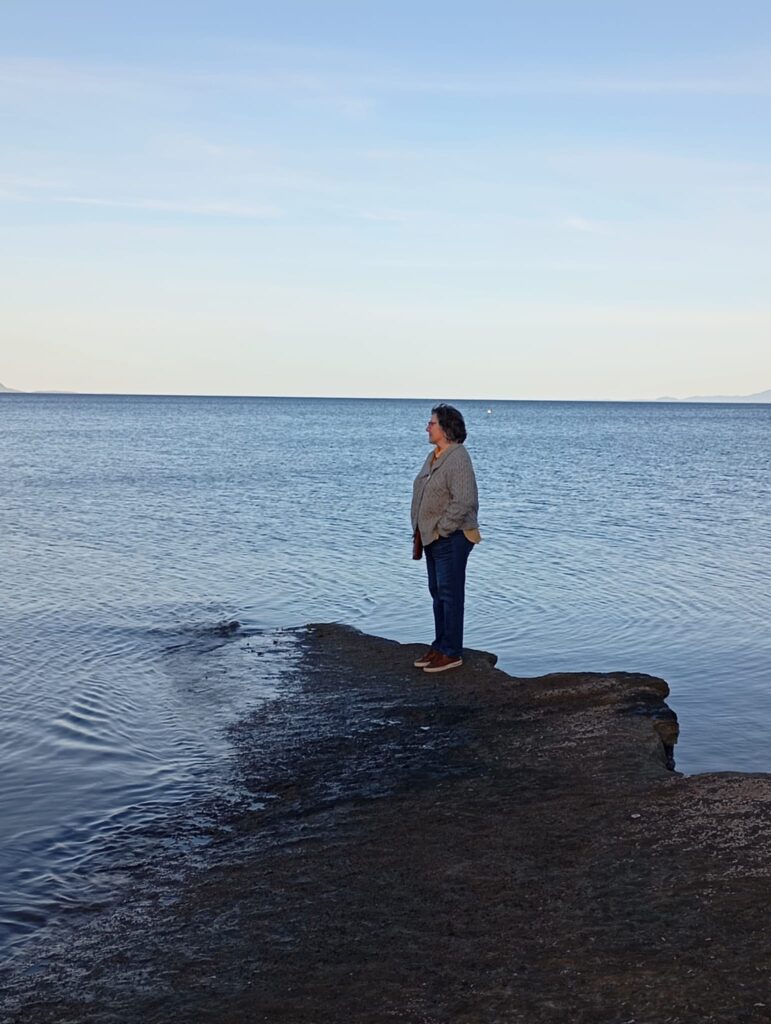
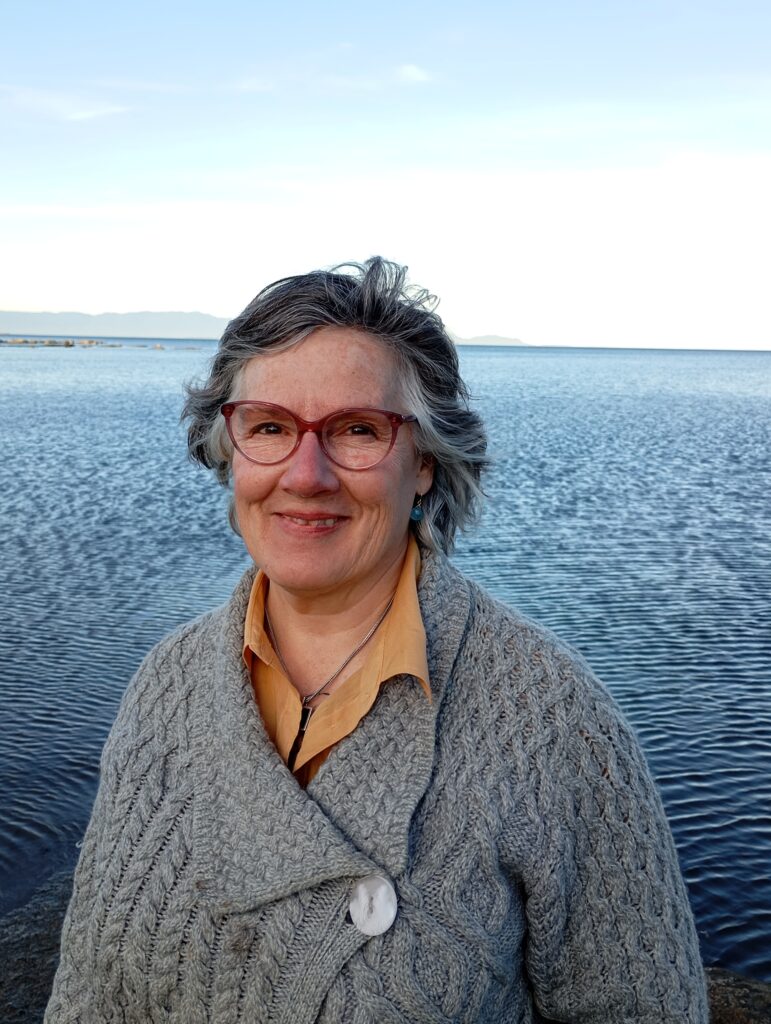
Rochelle Chinnery is a mixed-media artist who expresses herself through ceramics, photography, reflective writing, and poetry.
Her practice is grounded in a curious and mindful observation of the natural life of the land where she lives : Hornby Island, BC, Canada.
We first met at a singing practice, and one morning our paths crossed on the beach. I could feel the Water within her and asked if she would be up for a conversation. A few days later, we met again in her studio, and we chatted over a delicious cup of tea that she brewed for us.
I respectfully acknowledge that the land we gather on, Hornby Island, Ja-Dai-Aich, is part of the unceded traditional territory of the K’ómoks First Nation, the traditional keepers of this land, and that I am here as an uninvited guest.
CLÉO : Have you seen the documentary Ocean by David Attenborough?
ROCHELLE : No I haven’t.
CLÉO : It paints a catastrophic landscape of the consequence of industrial fishing, especially when the fishing trawlers rake the bottoms of the sea, and destroy the seabed. It’s devastating, but they also show how, when those practices are stopped and the places are left alone, life comes back. It just comes back so fast.
ROCHELLE : It’s incredible, it does come back. We have this whole property, it’s a small property, but the person who had it before took everything off, except for the fir trees, they cut down everything. There were arbutus trees, Garry oaks… And now 20 years later all the arbutus are starting to come back and the Garry oaks are also coming back. I think it is an endangered tree. But more than that, there’s a species of orchid that comes with the Garry oak, those are coming back too.
I’ll have to watch that documentary, I’m having a hard time watching things about destruction right now so I might save it for later.
CLÉO : It ends on a hopeful note. That also gives us the energy to keep fighting, or be activists I guess, otherwise we would just go to bed and never…
ROCHELLE : … and never wake up.
CLÉO : Yeah.
CLÉO : At the beginning of the interviews in general we spend a few minutes, or a few seconds, connecting to Water, if you don’t mind.
ROCHELLE : Absolutely, I’m up for it.
CLÉO : Connecting to Water in our body, sending gratitude to all the Water around us, and maybe asking that Water guides the conversation.
CLÉO : Thank you for agreeing to share.
ROCHELLE : Absolutely, I love that you’re doing this work, that’s terrific.
CLÉO : We met on the beach around two weeks ago, and you started sharing about your dreams. Do you want to start here with this?
ROCHELLE : Sure, I think we started with that because you told me that you had an irrational fear of Water, that you suddenly became afraid of it.
CLÉO : Yes.
ROCHELLE : I don’t know that I ever became afraid of Water, because I didn’t spend time by the Water. Even though Montreal, where I grew up, is an island, but it’s just barely an island. There’s Water around land and it is technically an island, but it’s not an island like this one, you know. So I didn’t have that realization when I was younger.
CLÉO : In which neighborhood did you grow up?
ROCHELLE : We were in a couple of different places, my family moved from Montreal to Ontario a few times, because my father was in the military. When I started to have these dreams about tsunamis, I was in the center of Montreal. We did have bridges, we were near the Jacques Cartier bridge, so there was this idea of Water.
I used to have these dreams where I would be standing outside, and the horizon line was the city, we lived just outside of downtown and we could see, you know, higher buildings, not skyrises, at the time Montreal was smaller. I used to stand outside and look. In my dream I was standing looking at the city and then I would see this darkening, and the darkening would get higher and higher until I realized that it was a tsunami. And by the time I realized that it was a tsunami I would wake up. It was this dark… it wasn’t Water, it was a blackness, it was a wall of cresting blackness that would come over me. I had dreams about that for years, this rising and crushing tsunami. As I wasn’t used to going to Water, you know we didn’t go swimming in the ocean or anything, my idea about what Water was informed by these urban tsunamis.
When I did finally learn about Water and when for the first time I saw the ocean, when I was 12, and I looked out at it, I thought: this doesn’t feel like it, this doesn’t feel like that.
Just to backtrack a bit, I did get kind of annoyed at these dreams. As a child I started having them really early on, maybe seven or eight, I’m not sure. But I do remember sitting in the car, driving with my parents and thinking about this dream that I had had the night before, worrying that I would have it that night again, and I made this promise to myself that I would not. The Water was not going to get the best of me. I wanted my dreams back. I did have this dream, the tsunami came again, but I was aware in the dream about the tsunami coming and I said « no ». I just thought it, I thought « no », and then I woke up and ever since then, I have had tsunami dreams, they’re rare now but I do still have them, but they are always in my control now.
And moving to a place where there is a lot of Water, also going on kayaking expeditions, with my husband, open ocean kayaking, was a direct challenge to that concept. I’ve never been a good swimmer because I had a very different relationship with Water. I won’t say that I’m afraid of Water, I am not afraid of Water, but I know the absolute damage that it can do. I know the power of Water, so it’s more like a kind of profound respect. I know people go into the Water and they play and they have great fun and I’ve never been one of those people because that is not my understanding of Water. My understanding of Water is not a play thing or a playground Water. I understand it can be fun you know, I have had fun on it and in it but that is not my primary understanding of Water. My primary understanding of Water is that it is very solemn. I mean that changes depending on if it is a little puddle… But looking out at any body of Water like we have here, looking out at it, I have absolute respect. Not fear, but it’s like Fire you know: you like to sit by a Fire, you like to be warmed up by the Fire, you enjoy, it’s beautiful, it does wonderful things. The Fire is Fire and Water is Water.
CLÉO : When you think about Water what is the first thing that you think about : is it the ecological aspect? I ask that as we are now in the middle of the « Herring Fest »*** here. Do you think more in terms of how to protect Water or how wondrous it is? ***(The HerringFest is an annual multi-day community and environmental celebration hosted by Conservancy Hornby Island in early spring to honor the vital Pacific herring spawn in the Salish Sea.)
ROCHELLE : My relationship with Water changed, for sure, because of the herring spawn. I don’t see Water the same way that I did before the herring spawn. The herring show this whole other side of Water, not just as a primary element, but as a living force itself. Not just with the herring, not just with animals and mammals, but that the Water is like heavy Air for them. The Water is like a different Air, the elemental quality of it changes because of what’s in it. I think there’s an aesthetic consideration with the herring too, because they change the Water that we’re familiar with, you know. We’re familiar with the Waters at Helliwell Park for example, these crashing waves, and this dark blue color. But when the herring show up, the Water itself just goes quiet and flat, and it turns into a turquoise color that is psychologically and emotionally affecting. It’s not just pretty, it’s something more. There’s some kind of an essential dynamic of that color on us, and no one who lives here is unaffected by that color. We all head to the Water to look at it. If you go to the herring show too, everyone’s artwork is turquoise, you know. Everything is the same color. It’s an affecting color. I have found for myself personally that it changes my relationship with the Water because there’s a different personality there. Water has so many personalities, this dark black Water, the dark indigo Waters of the winter but then they calm into a color that you wouldn’t expect here. I mean you usually see it in the tropics.
CLÉO : This turquoise color just to be clear, is it made by the eggs and the semen?
ROCHELLE : It is made by the milt. They call it the milt, it is essentially the fish semen. How the Water is changed into this color, it’s essentially life, it’s a life filled Water even more than it’s already life filled, you know. It’s supercharged. And then of course, there’s eggs all over the beach, it couldn’t be more literal. If you really didn’t understand it initially, it’s there in front of your eyes and you can’t miss it. It’s a phenomenon.
I think the more that people see it, they fall in love with the beauty of the thing, there’s some kind of aesthetic exchange from the Water that makes people understand how important it is, you know, and it certainly did that for me as well. The herring changed my relationship with Water, period. When we were just starting to talk and you said to take a minute to think about the Water and to thank it : I closed my eyes and I’m underwater with this bubbling… It’s boiling with fish. I have transported myself into this herring Water it’s just boiling with fish and it changed the Water from this basic element to, maybe, its full capacity, as an element.
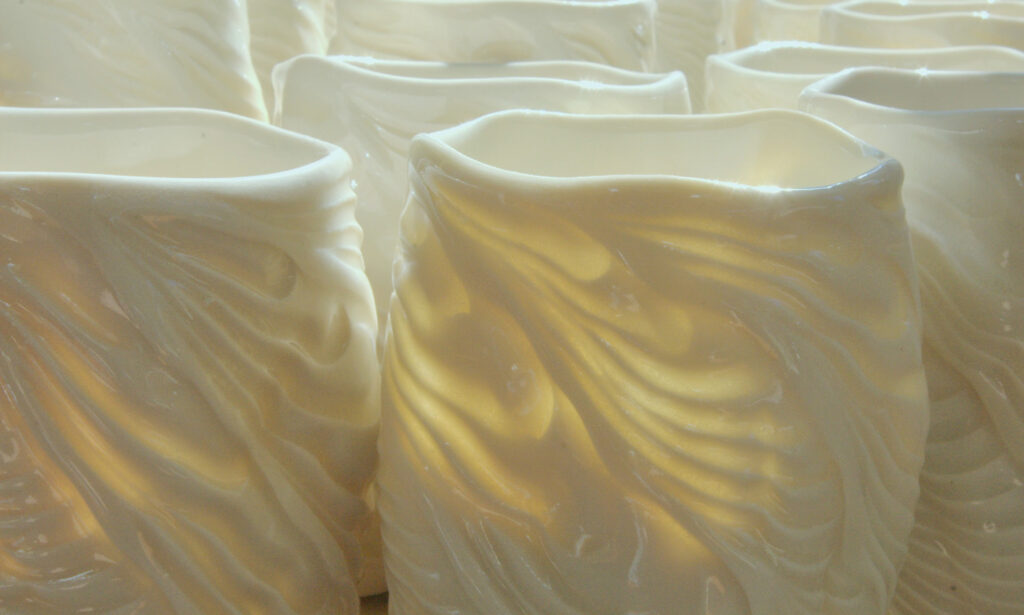
CLÉO : You are a potter, you work with Water, and clay. It looks to me that your shapes, patterns, might be inspired by the movement of Water?
ROCHELLE : The thing about ceramics is that it involves all of the elements. With the Fire element for me it’s electricity, I don’t fire with live flame. The thing about ceramics that is so intriguing, and I think intriguing to a lot of people, not only to me, is that it is fully elemental. There is the element of Earth, there’s Air, that’s the spaciousness, there’s Water, all the elements are present. And you have to be in it physically, directly. I mean some people use a lot of tools, I don’t. I’m very direct with what I do, the fewer the tools the better.
But certainly the patterning is an iterative patterning, so it’s not just the flow of Water, although it is the flow, it’s more like the effect of the flow of Water. This pattern shows up everywhere. It’s not just Water, in fact Water isn’t there, it’s the movement of the Water, right, it’s not it’s not the Water itself, it’s the movement of the Water. And the tracings, that iterative patterning, you see this without Water, you see it in the snow, you know, where the wind moves in this iterative flow pattern. It’s more of a kind of an essential flame, the flow patterns of flame, it’s the same, it’s a kind of fundamental patterning of living things, so wherever there’s life this pattern shows up.
CLÉO : You think about this when you create your pieces?
ROCHELLE : I don’t put it into words, but there is definitely an elemental kind of conditioning that has happened to bring the patterning about. I didn’t start off in a flow pattern, I started off just carving, and then the more I carved the more I naturally went to this kind of flow pattern that is in itself kind of relaxing, even just a breathing pattern, it’s all flow. I find that working that way does give me a kind of relaxing focus when I’m working. I really can just kind of disappear into it. In fact I know when I’m not disappearing into it and when I’m becoming more mechanical and conscious of what I’m doing because, that work, when it’s finished, it’s not as fluid. I can see it, maybe other people couldn’t see it as much as I can but I can see the difference between two pieces side by side : I was present for that piece, not present for that one.
CLÉO : Can you describe your life as having flow or yourself as a person following the flow? I understood that you were somehow able to catch the little nuggets of inspiration coming your way.
ROCHELLE : On good days. I would say on good days, but I wouldn’t characterize myself as a person who follows or who goes with the flow, I absolutely do not. I am not a go with the flow type unfortunately, but I know that, and I know when I need to step into the flow.
CLÉO : Maybe I got this idea by watching your Hornby Art video when you described how you started being a potter.
ROCHELLE : Oh, did you watch Zsofin’s video? That’s great. Yeah, it was metaphysical, it’s the most metaphysical thing I’ve experienced in my life. I didn’t like ceramics before I went to Japan, I didn’t care for pottery, I didn’t like it. I was in my early 30s when I went to Japan, it was pretty established I did not like pottery, but then when I got there, you know, all of the arts have a different presence, they just have a different presence than here. And ceramics is not different. I would say, for me it was much more pronounced than in any of the other arts, just in terms of its elementalness you know.
I went into a really small shop and became instant best friends with this elderly man behind the counter. He was very very friendly, and he just completely put me at ease. Why did I even walk into a pottery shop, I don’t know, but I did. I walked in and I sat down, he wanted to show me this cup, and he put a cup in my hand, a little brown cup. He put it in my hand and it was like he plugged in a little sim card into my hand, and I got all of the information. I’m not kidding, I rarely tell the story, I told the story to Zsofin because she was doing a film, but I rarely tell the story because it’s just impossible you know. He put a tiny pot in my hand and I understood it, 100%, I felt the Earth in it, there was a kind of geological impressioning, I kind of felt I knew where the earth was from, all of it was such an electrical download that I never got over it. And then, when I left the shop, within, I think it was a few days, it might have been a couple of weeks, but within a few days, I’m gonna say, I found a teacher, a pottery teacher, somebody who was doing it recreationally and I got INTO it. He knew that I was serious and then he recommended another teacher for me.
CLÉO :You were still in Japan ?
ROCHELLE : Yeah I was in Tokyo for a year and a half. I worked with this professional potter there, who let me do a few things but nothing major, because you have to start at the bottom and stay at the bottom for a generation before you can do anything in Japan. But then each teacher knew a teacher somewhere else and they recommended me so I went to another teacher in a different area, and on it went. I had three different teachers. I went there to teach English because I have a background in linguistics and I wanted to be a Spanish teacher, and it all just went to hell.
CLÉO : Wow.
ROCHELLE : This changed my whole life.
CLÉO : It’s a beautiful story, it’s magical and it’s great nowadays to hear such a story.
ROCHELLE : It’s unbelievable. I mean, it’s not believable. Now I can explain it as a kind of sim card because we have this idea of this little tiny piece of metal put into another machine and it explodes into a world of knowledge. Now we have this physical thing that people can relate to but before we had this technology, all I could say was : the man put a cup in my hand and I lost my mind. That was all I could ever say, until this technology gave me something actually tangible. It’s not relatable but you can understand the process of what happened.
It completely upset my life. I was in grad school before I went to Japan, and I quit to go to Japan to pay off my student loan. My plan was to come back and to carry on. The whole idea was dead. I came back, I went to art school when I was 35 years old, you know, and it wasn’t good enough for me, it wasn’t enough because I was expecting Japan to be in Canada and it wasn’t. So I left. I finished that year of art school, I came to Vancouver and I tried another year of art school at Emily Carr and it still wasn’t Japan, it just wasn’t enough, so I bought a kiln and I just did my own thing, I became self-taught after that. There were so many limitations but even still I couldn’t not pursue that. There wasn’t an alternative for me at that point.
CLÉO : Could you share this experience with an artist, or with one of your teachers who could understand?
ROCHELLE : Definitely, they all understood it, you know, because in ceramics most people study Japanese ceramics. Most of my ceramics teachers in school had not been to Japan but they understood the phenomenon. I think that anybody who does go to Japan who has an affinity for material, who goes to Japan to study or just to even look at the work, comes back different because of the level, the depth of exploration.
CLÉO : You never considered staying?
ROCHELLE : I did consider staying there, but it was one of those things where I was in my mid-30s, and I was single, and I wasn’t sure that I wanted that to be my life. Before I left for Japan I was dating Doug, my husband, and we dumped each other, and I went to Japan expecting to be away for a year or so, and then it became four years. When I came back and I went to art school, we got back together a bit, and then when I came back to Vancouver we got married. I kind of left Japan to be with Doug.
CLÉO : It’s great that you left Doug to go to Japan as well.
ROCHELLE : Yeah well it wasn’t great at the time it was a failed relationship. (Laugh)
CLÉO : Yes, but people often cling to each other or stay around hoping to get back together.
ROCHELLE : Oh yeah no that was a clean break, neither of us was clinging, it was like : sayonara, see you later. And he had huge emotional growth on his own, I had huge emotional growth on my own, and when we came back together we had more in common than we did before.
CLÉO : Beautiful.
ROCHELLE : Yeah, it was completely unexpected.
CLÉO : When you were in Japan and also here, on Hornby Island, were you ever thinking about tsunamis? I think here we are somehow sheltered by Vancouver Island, but Japan is tsunami country.
ROCHELLE : Yeah, Japan is tsunami country. They didn’t have any when I was there, they did have earthquakes. There were historic places all the way, all along the coast. Japan is a country of natural disasters, hundreds of people die every year from the weather in Japan, it’s just part of it.
I feel and I’m sure other people feel this too, that the land itself is so impermanent that it gives rise to the concepts within buddhism and shintoism that life is elemental, we were born and we definitely die. Here we don’t have that sense of impermanence, we’re always shocked when someone dies. We don’t incorporate death into our lives. I think that’s part of the reason why fragility and beauty show up differently in Japan than they do in Western culture, because there they are so acutely aware of death, and we don’t have that, we don’t build it into our culture. I think that’s part of what gives Japanese craft, Japanese arts their beauty. They have a sense of it, they build it right in, and they pour life into their artwork in a different way. It’s so profoundly committed, because tomorrow you’re gone, you know.
But, yeah it’s filled with tsunami folklore and history, archival history. There’s a Daibutsu, a giant metal Buddha that was uncovered in a tsunami. The people of this one region somehow forgot about it, and it got buried over, it was covered in stuff, who knows what. Then one day, there was this massive tsunami and it tore the village away with it, but then, lo and behold, there’s this giant metal Buddha statue standing. So some good, some bad, mostly bad but that was an amazing thing.
I do remember when the Fukushima tsunami happened, I was living here and I think 15 000 people were killed in that tsunami, it was a proper horrible tsunami. I was in Courtenay having a coffee, and the situation of it was going through my mind, I was in a cafe drinking my coffee and I looked up out of the window, somebody were pulling a boat behind their car, but I saw this boat going down the street just in a second, and in an instant I had this tumbling feeling, I lost equilibrium and I became instantly sick. It was just so affecting.
I have felt for a long time that there’s some reason why I have this kind of embodied sense of tsunami. My sister put it together because my great-grandmother, my great-grandparents came from southern Italy, there was a mass migration from Messina/Reggio, I think it was 1908. There was a massive earthquake like a 7.5 or 8 and there was a tsunami. It was a type of earthquake that I don’t know what they call but they happen when the Earth slides down, it pushes up the Water, and so there was this massive earthquake that was followed by a 30 meters wave, the sea came and it took out the city of Messina and part of Reggio as well. And there was a mass migration from that area of Italy to the Americas after that because the cities were wiped out. People were already poor, now they were poorer and homeless and my great-grandparents were a part of that.
Because I’ve lived so long with this sensation of tsunami in my body and because when I saw this boat go by I felt it occupied my body, I felt like I was hit by a wall of Water, and it was disorienting, and and I got sick, my sister was the one who made a connection with epigenetic. Epigenetics, it’s a thing, and I had been studying it too, but in the context of war because my father’s family for 400 years in Canada, have been in the military, so I was focused on that. But my sister said, you know, when I told her the story I’ve just told you : « I think there’s a little bit of tsunami in you ».
However it works, maybe it’s not quite so literal, but the lore is there, and the understanding of the experience is there, and certainly I didn’t have that conscious experience of getting instantly sick when the boat went by, it just you know I felt like tumbling in Water. Which was not my grandmother’s experience, she escaped, she didn’t drown, but there was something in there where I was taken somewhere else.
I think some of us are situated in this field of knowing and then it comes up in some of us.
I wonder about your experience, what is your experience : like you said, we have the same experience, I have no reason to feel those fears, I didn’t grow up around Water I’ve never experienced a tsunami, I’ve never seen one live, I’ve seen a big wave, that’s it, and who hasn’t.
Where are we in this kind of field where we can be completely unconsciously and consciously thrown into the experience of this with no physical experience of this in our lifetime?
CLÉO : I later connected my fear of Water to the fear of feeling emotions, and the fear of being submerged by something I cannot control. There was so much that needed to be felt and had been repressed, some of it belonging to me and also coming from my family, my lineage.
I felt it was my duty to feel all, and I was not spontaneously up for it.
ROCHELLE : You are the final expression of all of that.
CLÉO : Yeah it emerges in one of us and we’re like : « Oh there is all this, and that, what is it? I don’t know if I like it, but I also cannot ignore it. »
(Laughs)
ROCHELLE : It’s really true.
CLÉO : Now I take it as a sort of gift of which I’m curious about, instead of being really dramatically afraid.
ROCHELLE : You’ve been able to make it conscious, you’re consciously reflecting, that’s fascinating. Instead of being inhabited by the fear of something unknown, you’ve seen the fear, you’ve articulated the fear, and so now it can be kind of safely handled : I’m not in this, I’m not in this.
CLÉO : I have to do this regularly, to re-articulate it, because sometimes I’m becoming it again, and it’s a constant remembering that I can step out. But it does give a sense of purpose and creative Fire as well.
ROCHELLE : Absolutely yeah, it does.
When I connect with other people who have this sense of massive Water, that it is elemental emotionally, psychically, metaphysically, there’s a representation of Water that, as a western person, we have to look for the for the meaning for ourselves because it’s not something that our cultures, maybe more more so in your culture i don’t know, but in western culture it’s absent you know. Our beingness is very concrete and so when we get washed away with all this kind of metaphysical symbolism we have to navigate that on our own. As children we had to try to understand that from within our own bodies, as children we connected with this invisible force that we have. It doesn’t come from nowhere, it’s not nothing, it’s a thing, it’s a real thing, it’s a thing that’s strong enough that it’s disorienting and it affects us every day. It’s not nothing, so what is it?
(Laughs)
CLÉO : That’s the question, I thought I had gathered some answers, and more and more I realize I don’t.
ROCHELLE : I don’t know that it’s answerable to tell you the truth. I don’t think it’s answerable. I think it’s a relationship of engagement, I think that there are kinds of ways of recognizing our own fears of it or our own being with it. I don’t think it’s solvable because I don’t think we have conscious capacity for that magnitude you know, let alone the language for it, you know in whichever language you speak. I think it’s a kind of coexistence or an inter-existence to make up a term but I don’t expect this solution, you know. Every time I have one little bit of understanding, that’s just a little bit of understanding. But I have been so grateful for the herring phenomenon, because it’s given me this whole other capacity for understanding.
There’s a woman on the island, I think she lives here part-time still, Rebecca, she became a free diver and she goes in with her mask and her bodysuit and a camera and she has been right in the middle of a herring ball. There is footage that she has taken, she showed us so I know what her perception was, of just being in this boiling water, it’s magnificent. I have dreams when the herring are here, I have those dreams instead, I can go in it and be in that presence of Water in a way that I never could have done before.
CLÉO : When you say dreams is it dreams at night?
ROCHELLE : Dreams at night, sleeping dreams you know, and even in a kind of focused meditative state, not for very long but just to go into that. Like when we were at the very beginning of this talk, connecting to Water, that was where I was, in this herring ball in the Water. (Laughs) I think you can walk yourself into different experiences of Water but I have had to do this very consciously and also very carefully. I’m trying to be very careful that I don’t take it too literally or try to fix anything. I have this very particular relationship with Water, it is my thing, I’m not trying to fix it, I’m not trying to make it better. I find this phenomenon of a black tsunami coming over Montreal incredible, you know. This is a science fiction vision that you could only have in a dream. Although some people have seen exactly that, and in our lifetimes too I mean I’ve watched footage, I’ve seen films, real films of that happening. Black black water, not several hundred meters high but high enough that you get the point, and I think when you have that kind of range, you know, it’s a range, I mean that it is a massively engulfing feeling. To be able to have that emotional range is a gift but I couldn’t understand that as a child, and I’ve spent my life trying to reconcile that gift because it’s a bit of a nightmare to be honest, to have that kind of emotional capacity. It is terrifying.
CLÉO : Do you have visions of the future ?
ROCHELLE : They’re a combination of catastrophic and hopeful.
CLÉO : I was meaning more for your emotional capacity.
ROCHELLE : Yes, yes, I see a kind of catastrophe, because ultimately we die. That is a catastrophe, but it isn’t. But we having been alive and facing this end it’s horrifying, it’s terrifying, but at the same time we can temper that. I’ve been in training my whole life to be afraid of death, this culture has taught us that. It doesn’t come readily I think to any of us, well I just can speak for myself at least.
CLÉO : Do you prepare yourself for death ?
ROCHELLE : I have prepared, I think, because I have been close to death. Because being in the condition of being so overwhelmed by emotions I have a number of times, not recently, but a number of times, considered death, suicide, and I had plans, I knew how to do it. Also I did have a catastrophic injury at one point that left me in so much pain for so many years that that seemed like the only way out, so I was ready for it. So I do see a kind of catastrophic end but I don’t fear it the same way. I know that when I walk into it, I can’t help it (laugh), it is going to happen, I can’t stop it. All I can do is know that I am a mortal person and if I live well that’s the best I can do, and I think I’ve lived well.
What about you, what do you think?
CLÉO : When I sit with death I feel more at peace than when I try to avoid thinking about it.
ROCHELLE : Right.
CLÉO : I practiced the cadaver meditation, where we see ourselves being dead and slowly decomposing, becoming dust… I felt more alive than ever afterwards. I also had a death wish a number of times, also because of this unbearable emotional turmoil. I also thought that maybe it was easier to be dead than alive. I think what I fear is the surprise that it can come anytime, in a way that is not convenient for other people as well.
ROCHELLE : Right, yeah, I think as you get older too and these surprise deaths happen, then you start to get it, it’s not just old people who have lived their complete life and they naturally die, it’s not that, it’s these random shocking ones. You don’t get any warning.
CLÉO : I realized that part of growing older is to have many people dying. The older you are the more people you lose or you’ve seen die.
ROCHELLE : Yes.
CLÉO : It’s disconcerting.
(Laugh)
ROCHELLE : It’s disconcerting, and at the same time I think if you’re lucky, it’s the wake-up call that this doesn’t go on forever. I used to have 10-year plans, or five years, like oh okay I’m going to start this now and then in five years I’ll have this you know, whether it’s studies, whatever it is, and then I will do blah blah blah. And now I don’t have those plans, if I have a plan it should happen within six months or a year. I have found that getting to the age that I am, 66 almost 67, is that you can’t count on more, you can’t count on it. I can’t say, you know, in five years this is what I want to do, great, maybe five years doesn’t come, so if you want to do something, it has to be a closer plan. I think that’s one of the benefits of that kind of emotional acuity that comes with the privilege of getting older, is that this doesn’t go on forever and ever. That wasn’t something people had to think about in Japan, that’s a given, you’re raised with that idea.
We’re not raised with that idea here.
CLÉO : I felt that when I was living in Brazil as well. The fragility of life and the body was much more apparent than here. People didn’t seem grossed out by infirmities, disease, and by extension, death. It was everywhere in plain sight, not taboo. It was accompanied by a sense of aliveness and joy, humor.
ROCHELLE : I have to agree. Actually, in January I took a course on death. It was a one week course on how to be in a relationship with people who were dying. There were people in the course who had a lot more experience than I do and who work in hospices, in palliative care, some people were therapists, other people were volunteering in hospitals but they wanted to know more. Every person, every single person said their lives had improved the more they knew about death, the more they had been around death, the more they spoke with dying people, they found that their lives had improved, because of this sense of impermanence. They lost a sense of permanence and that made them feel better about everything, you know. Waking up in the morning was a gift now.
CLÉO : I tried to conjure it every day but it’s not always working.
ROCHELLE : No it doesn’t, and I think it doesn’t until there’s a certain number of shocks in your life, because it’s not part of western culture, it’s not present. We don’t live with ghosts, we don’t live with this idea of the dead walking amongst us either. Whereas other cultures certainly do. Maybe where you were in Brazil, certainly in Japan there’s this idea of death being with you, it is there, and also dead people being there too, and it changes the social landscape in a good way I think.
CLÉO : Thank you for sharing all this.
ROCHELLE : Absolutely, thank you.
CLÉO : Maybe to conclude, would you like to say something about the orcas dreams that you mentioned to me the other day? I don’t know if it’s a short or a long story?
ROCHELLE : I think it’s a pretty short story. As I said I grew up in Montreal, and for some reason I was frequently visited in my dreams by orcas. The one that I remember the best is: I was a kid, I was married to an orca, (laugh) and this orca was just swimming around the house, it was just there. In Montreal in the 1960s we didn’t have a television in until I was maybe five or six, and we didn’t watch it very much, it was a special occasion. So I’m not sure where the imagery of the orca, let alone the capacity to imagine it swimming, the underwater filming of it, I am not even sure that that had happened by then. But I had these dreams of these orcas. And, many years later, when we moved here on Hornby, I knew that they were around, but they really are around in the wintertime especially, now too (in March) because of the herring spawn, this is where they are. It’s a really strange thing for me to have kind of come through in this, it feels like an hourglass, where I’m in the middle of that hourglass right now, this meeting point between tsunami and orca and Water. There’s this really interesting kind of meeting point in this place and time for me. I’m not sure how I got here, I never imagined myself living on an island, doing so was not part of my imagining. I was going to be a professor in a university in a big city teaching languages or at least studying languages. Not this, and not ceramics for sure. Anyway, here I am.
꩜꩜꩜
VERSION FRANÇAISE (traduite de l’anglais)
Rochelle Chinnery est une artiste multidisciplinaire qui s’exprime à travers la céramique, la photographie, l’écriture introspective et la poésie.
Son travail s’appuie sur une observation curieuse et attentive de la vie naturelle du territoire où elle vit : l’île Hornby, en Colombie-Britannique, au Canada.
Nous nous sommes d’abord rencontrées lors de cercles de chant, puis un matin, nos chemins se sont croisés sur la plage. J’ai pu sentir l’Eau en elle et je lui ai demandé si elle serait partante pour une conversation. Quelques jours plus tard, nous nous sommes retrouvées dans son atelier, et nous avons discuté autour du délicieux thé qu’elle nous avait préparé.
Je reconnais respectueusement que le territoire sur lequel nous sommes réuni.e.s, l’île Hornby, Ja-Dai-Aich, fait partie du territoire traditionnel non cédé de la Première Nation des K’ómoks, gardien.ne.s traditionnels de cette terre, et que je suis ici en tant que visiteuse non invitée.
CLÉO : As-tu vu le documentaire Océan de David Attenborough ?
ROCHELLE : Non, je ne l’ai pas vu.
CLÉO : Il dresse un paysage catastrophique des conséquences de la pêche industrielle, en particulier lorsque les chalutiers raclent les fonds marins et détruisent tout sur leur passage. C’est dévastateur, mais ils montrent aussi comment, lorsque ces pratiques cessent et que ces endroits sont laissés tranquilles, la vie revient. Elle revient vraiment vite.
ROCHELLE : C’est incroyable, oui, elle revient. Nous avons une petite propriété ici, et les personnes qui l’avait avant nous avait tout enlevé, sauf les sapins ; ils avaient tout coupé. Il y avait des arbousiers d’Amérique, des chênes de Garry… Et maintenant, vingt ans plus tard, les arbousiers commencent à revenir, les chênes de Garry aussi. Je crois même que c’est un arbre menacé. Il y a une espèce d’orchidée qui cohabite avec les chênes, et elles reviennent elles aussi.
Il va falloir que je regarde ce documentaire, mais j’ai du mal en ce moment à regarder des choses sur la destruction, alors je vais peut-être le garder pour plus tard.
CLÉO : Ça se termine sur une note d’espoir. Ce qui nous donne l’énergie de continuer à nous battre, ou à être activistes je suppose, sinon on irait simplement se coucher et…
ROCHELLE : … et on ne se réveillerait jamais.
CLÉO : Oui.
CLÉO : Au début des entrevues en général, nous passons quelques minutes, ou quelques secondes, à nous connecter à l’Eau, si cela ne te dérange pas.
ROCHELLE : Absolument, je suis partante.
CLÉO : On peut se connecter à l’Eau dans notre corps, envoyer de la gratitude à toute l’Eau autour de nous, et peut-être demander à cette Eau de guider la conversation.
CLÉO : Merci d’avoir accepté de partager.
ROCHELLE : Absolument, j’adore que tu fasses ce travail, c’est formidable.
CLÉO : Nous nous sommes croisées sur la plage il y a environ deux semaines, et tu m’avais parlé de tes rêves. Veux-tu commencer avec ça ?
ROCHELLE : Bien sûr, je pense qu’on a parlé de ça parce que tu m’as dit que tu avais une peur irrationnelle de l’Eau, que c’étais arrivé soudainement.
CLÉO : Oui.
ROCHELLE : Moi, je ne sais pas si je suis devenue effrayée par l’Eau, parce que, enfant, je ne passais pas de temps près de l’Eau. Montréal, où j’ai grandi, est une île, mais on ne s’en rend pas vraiment compte. Il y a de l’Eau autour de la terre et c’est techniquement une île, mais ce n’est pas une île comme celle-ci, tu vois. Donc je n’avais pas cette réalisation quand j’étais plus jeune.
CLÉO : Dans quel quartier as-tu grandi ?
ROCHELLE : Nous avons vécu à plusieurs endroits différents, ma famille a déménagé plusieurs fois de Montréal à l’Ontario, parce que mon père était dans l’armée. Quand j’ai commencé à faire ces rêves de tsunamis, nous étions dans le centre-ville de Montréal. Il y avait des ponts, nous étions près du pont Jacques-Cartier, donc il y avait cette idée de l’Eau.
J’avais l’habitude de faire ces rêves où je me tenais debout dehors, la ligne d’horizon était la ville ; nous vivions juste à l’extérieur du centre-ville et nous pouvions voir de grands édifices, mais pas encore de gratte-ciel car à l’époque Montréal était plus petite. J’avais l’habitude de rester dehors et de regarder. Dans mon rêve, je regardais la ville et ensuite je voyais une noirceur émerger, et cette noirceur devenait de plus en plus haute jusqu’à ce que je réalise que c’était un tsunami. Et au moment où je réalisais que c’était un tsunami, je me réveillais. Ce n’était pas de l’Eau, c’était un mur de noirceur écumante qui venait sur moi. J’ai fait ces rêves pendant des années, ce tsunami montant et s’écrasant. Comme je n’avais pas l’habitude d’aller près de l’Eau, tu sais, nous n’allions pas nager dans l’océan ou quoi que ce soit, mon idée de ce qu’était l’Eau était informée par ces tsunamis urbains.
Quand j’ai finalement appris à connaître l’Eau et que, pour la première fois à l’âge de douze ans, j’ai vu l’océan, et que je l’ai regardé, je me suis dit : ça ne ressemble pas du tout à ça.
Juste pour revenir un peu en arrière, j’ai fini par être un peu agacée par ces rêves. Enfant, j’ai commencé à les avoir très tôt, peut-être vers sept ou huit ans, je ne suis pas sûre. Mais je me souviens être assise dans la voiture avec mes parents, en train de rouler, et penser à ce rêve que j’avais eu la nuit précédente, m’inquiétant de l’avoir encore cette nuit-là. Je me suis alors fait cette promesse : je ne l’aurais plus, l’Eau n’allait pas avoir le dessus sur moi. Je voulais retrouver mes rêves. J’ai de nouveau fait ce rêve, le tsunami est revenu, mais j’étais consciente dans le rêve que le tsunami arrivait et j’ai dit « non ». Je l’ai simplement pensé : « non ». Je me suis réveillée et depuis ce moment-là, j’ai encore des rêves de tsunamis, ils sont rares maintenant, et ils sont désormais toujours sous mon contrôle.
Le fait de déménager dans un endroit où il y a beaucoup d’Eau, de partir en expéditions de kayak avec mon mari, du kayak en pleine mer, était un défi direct à ce concept. Je n’ai jamais été une bonne nageuse parce que j’avais une relation très différente à l’Eau. Je ne dirais pas que j’ai peur de l’Eau, je n’en ai pas peur, mais je connais les dégâts absolus qu’elle peut faire. Je connais la puissance de l’Eau, donc c’est plutôt une sorte de respect profond. Je sais que les gens vont dans l’Eau, ils jouent et s’amusent énormément, et je n’ai jamais été une de ces personnes parce que ce n’est pas ma compréhension de l’Eau. Pour moi, l’Eau n’est pas un terrain de jeu. Je comprends qu’elle puisse être amusante, tu sais, je me suis amusée dessus et dedans, mais ce n’est pas ma compréhension première de l’Eau. Ma compréhension première de l’Eau est qu’elle est très solennelle. Bien sûr cela change selon s’il s’agit d’une petite flaque… Mais quand je regarde une étendue d’Eau comme celle que nous avons ici, j’ai un respect absolu. Pas de la peur, mais c’est comme le Feu, tu sais : tu aimes t’asseoir près du Feu, tu aimes être réchauffée par le Feu, tu apprécies, c’est beau, ça fait des choses merveilleuses. Le Feu est le Feu et l’Eau est l’Eau.
CLÉO : Quand tu penses à l’Eau, quelle est la première chose à laquelle tu penses : est-ce l’aspect écologique ? Je demande ça parce que nous sommes maintenant en plein « Herring Fest »*** ici. Penses-tu davantage à la façon de protéger l’Eau ou plutôt à quel point elle est merveilleuse et fascinante. ***(Le HerringFest est une fête communautaire et environnementale annuelle qui se déroule sur plusieurs jours et est organisée par Conservancy Hornby Island au début du printemps afin de célébrer la fraie du hareng du Pacifique dans la mer des Salish.)
ROCHELLE : Ma relation à l’Eau a changé, c’est certain, à cause de la fraie des harengs. Je ne vois plus l’Eau de la même manière qu’avant. Les harengs exposent un tout autre aspect de l’Eau, non seulement comme élément primaire, mais comme force vivante elle-même. Pas seulement avec les harengs, pas seulement avec les animaux et les mammifères, mais car l’Eau est comme de l’Air lourd pour eux. L’Eau est comme un Air différent ; la qualité élémentaire de celle-ci change à cause de ce qu’elle contient.
Je pense qu’il y a aussi une dimension esthétique avec les harengs, parce qu’ils modifient l’Eau qui nous est familière, tu sais. Nous sommes familières des Eaux du parc Helliwell, avec des vagues déferlantes et une couleur bleu foncé. Mais quand les harengs arrivent, l’Eau devient calme et plate, et elle prend une couleur turquoise qui a un impact psychologique et émotionnel sur nous. Ce n’est pas seulement joli, c’est plus que ça. Personne ici n’est indifférent(e) à cette couleur. Nous allons tou(te)s vers l’Eau pour la regarder. Si tu vas à l’exposition d’art du Herring Fest, toutes les œuvres sont turquoise, tu sais. Tout est de la même couleur. C’est une couleur qui a un effet sur nous. Personnellement, j’ai trouvé que cela changeait ma relation à l’Eau parce qu’on lui découvre une personnalité différente. L’Eau a tellement de personnalités : cette Eau noire sombre, les Eaux indigo foncé de l’hiver, puis elles se calment et prennent cette couleur turquoise à laquelle on ne s’attendrait pas ici. On voit plutôt cette couleur turquoise sous les tropiques.
CLÉO : Cette couleur turquoise, juste pour être claire, elle est créée par les œufs et le sperme des harengs ?
ROCHELLE : Elle est créée par la laitance. On appelle ça la laitance, c’est essentiellement le sperme des poissons. La manière dont l’Eau prend cette couleur, c’est essentiellement la vie ; c’est une Eau remplie de vie encore plus qu’elle ne l’est déjà, tu vois. Elle est surchargée. Et puis bien sûr, il y a des œufs partout sur la plage, ça ne pourrait pas être plus littéral. Si vraiment tu ne le comprenais pas au départ, c’est là devant tes yeux et tu ne peux pas le manquer. C’est un vrai phénomène.
Je pense que plus les gens le voient, plus ils tombent amoureux de la beauté de la chose ; il y a une sorte d’échange esthétique venant de l’Eau qui fait comprendre aux gens à quel point c’est important, tu sais, et ça a certainement été le cas pour moi. Les harengs ont changé ma relation à l’Eau, point final. Quand nous avons commencé à parler et que tu as proposé de prendre une minute pour penser à l’Eau et la remercier : j’ai fermé les yeux et j’étais sous l’eau avec ce bouillonnement… Ça bouillonnait de poissons. Je me suis transportée dans cette Eau de harengs, elle bouillonne de poissons, et cela l’a changée, d’un élément primaire, à peut-être sa pleine capacité en tant qu’élément.
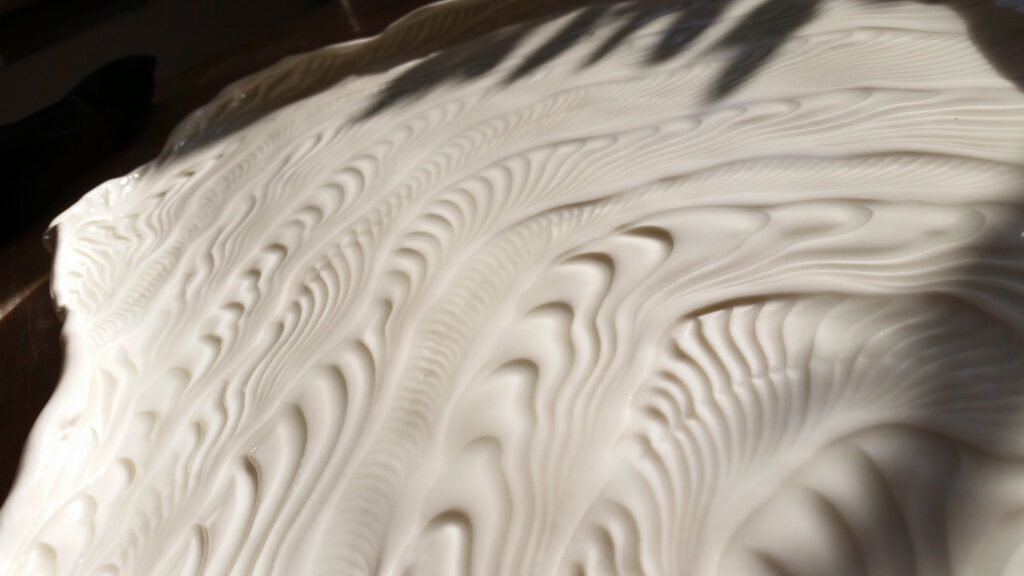
CLÉO : Tu es potière, tu travailles avec l’Eau et l’argile. Il me semble que tes formes, tes motifs, sont inspirés par le mouvement de l’Eau ?
ROCHELLE : Le truc avec la céramique, c’est qu’elle implique tous les éléments. Pour moi, l’élément Feu est l’électricité, je ne cuis pas à flamme directe. Ce qui est si fascinant dans la céramique c’est qu’elle est entièrement élémentaire. Il y a l’élément Terre, il y a l’Air, c’est l’espace, il y a l’Eau, tous les éléments sont présents. Et tu dois être dedans physiquement, directement. Certaines personnes utilisent beaucoup d’outils, moi non. Je suis très directe dans ce que je fais ; moins il y a d’outils, mieux c’est.
Mais certainement, les motifs sont des motifs itératifs, ce n’est pas seulement le flux de l’Eau, c’est davantage l’effet du flux de l’Eau. Ce motif apparaît partout. Ce n’est pas seulement l’Eau ; en fait l’Eau n’est pas là, c’est le mouvement de l’Eau, tu vois, ce n’est pas l’Eau elle-même. Et ces tracés, ces motifs itératifs, on les voit sans Eau, on les voit dans la neige, là où le vent se déplace selon ce motif fluide et répétitif. C’est davantage une sorte de flamme essentielle ; les motifs du mouvement de la flamme, c’est pareil, c’est une sorte de motif fondamental du vivant, donc partout où il y a de la vie ce motif apparaît.
CLÉO : Tu penses à cela quand tu crées tes pièces ?
ROCHELLE : Je ne le mets pas en mots, mais il y a définitivement une sorte de conditionnement élémentaire qui s’est produit pour faire émerger ces motifs. Je n’ai pas commencé avec un motif de flux, j’ai commencé simplement à sculpter, puis plus je sculptais plus j’allais naturellement vers ce type de motif fluide qui est en lui-même assez relaxant, comme un rythme de respiration. Je trouve que travailler ainsi me donne une sorte de concentration détendue. Je me dissous dans le processus. Je sais quand je ne dissous pas et quand je deviens plus mécanique et consciente de ce que je fais parce que ce travail-là, quand il est terminé, n’est pas aussi fluide. Je peux le voir ; peut-être que d’autres personnes ne le verraient pas autant que moi mais je vois la différence entre deux pièces côte à côte : j’étais présente pour cette pièce-là, pas présente pour celle-ci.
CLÉO : Peux-tu décrire ta vie comme étant fluide, ou toi-même comme quelqu’un qui se laisse porter par le courant ? J’ai eu l’impression que tu étais capable de reconnaitre les petites pépites d’inspiration qui arrivaient vers toi.
ROCHELLE : Les bons jours, mais je ne me décrirais pas comme une personne qui suit le courant ou qui se laisse porter, absolument pas. Je ne suis malheureusement pas du tout du genre à suivre le courant, mais je le sais, et je sais quand j’ai besoin d’entrer dans le flux.
CLÉO : Peut-être que j’ai eu cette idée en regardant ta vidéo Hornby Art où tu décrivais comment tu étais devenue potière.
ROCHELLE : Oh, tu as regardé la vidéo de Zsofin ? C’est super. Oui, c’était métaphysique, c’est la chose la plus métaphysique que j’ai vécue dans ma vie. Je n’aimais pas la céramique avant d’aller au Japon, je ne m’intéressais pas à la poterie. J’avais un peu plus de trente ans quand je suis partie au Japon, et c’était déjà bien établi : je n’aimais pas la poterie. Mais quand je suis arrivée là-bas, tu sais, tous les arts ont une présence différente, une présence totalement différente d’ici. Et la céramique ne fait pas exception. Je dirais même que pour moi c’était beaucoup plus prononcé que dans les autres arts, juste en termes « d’élémentarité », tu vois.
Je suis entrée dans une toute petite boutique et je suis instantanément devenue meilleure amie avec ce vieil homme derrière le comptoir. Il était très très amical et il m’a immédiatement mise à l’aise. Pourquoi suis-je suis entrée dans une boutique de poterie, je ne sais pas, mais je l’ai fait. Je suis entrée et je me suis assise, et il m’a mis une tasse dans les mains, une petite tasse brune. Quand il me l’a mise dans la main c’était comme s’il y avait branché une petite carte SIM, et j’ai reçu toutes ces informations. Je ne plaisante pas, je raconte rarement cette histoire ; je l’ai racontée à Zsofin parce qu’elle faisait un film, mais je la raconte rarement parce que c’est impossible, tu vois. Il m’a mis un petit pot dans la main et je l’ai compris, à 100 %. J’ai senti la Terre dedans, il y avait une sorte d’empreinte géologique, j’avais l’impression de savoir d’où venait la terre. Tout cela était un téléchargement électrique si intense que je ne m’en suis jamais remise. Et ensuite, quelques jours après avoir quitté la boutique, j’ai trouvé un professeur de poterie, quelqu’un qui pratiquait ça comme loisir, et je suis tombée DEDANS. Il savait que j’étais sérieuse et il m’a ensuite recommandé un autre professeur.
CLÉO : Tu étais encore au Japon ?
ROCHELLE : Oui, j’étais à Tokyo pendant un an et demi. J’ai travaillé avec ce potier professionnel là-bas, qui m’a laissé faire quelques petites choses mais rien de majeur, parce qu’il faut commencer tout en bas et y rester une génération avant de pouvoir faire quoi que ce soit au Japon. Mais ensuite chaque professeur connaissait un autre professeur ailleurs et ils me recommandaient, alors je suis allée voir un autre professeur dans une autre région, et ainsi de suite. J’ai eu trois profs différents. J’étais allée là-bas pour enseigner l’anglais parce que j’ai une formation en linguistique, mon but était ensuite de devenir professeure d’espagnol, et tout est parti en vrille.
CLÉO : Waouh.
ROCHELLE : Ça a changé toute ma vie.
CLÉO : C’est une belle histoire, c’est magique et c’est formidable d’entendre une telle histoire de nos jours.
ROCHELLE : C’est incroyable. Enfin : ce n’est pas croyable. Maintenant je peux l’expliquer comme une sorte de carte SIM parce qu’on peut visualiser ce petit morceau de métal qu’on met dans une autre machine et qui explose en un monde de connaissances. Maintenant nous avons cette chose physique à laquelle les gens peuvent se rapporter, mais avant cette technologie tout ce que je pouvais dire c’était : cet homme m’a mis une tasse dans la main et j’ai perdu la tête.
Cela a complètement bouleversé ma vie. J’étais à l’université avant de partir, et j’ai arrêté pour aller travailler au Japon afin de rembourser mon prêt étudiant. Mon plan était de revenir et de continuer. Ce projet est tombé à l’eau. Je suis revenue, j’avais trente-cinq ans et je me suis inscrite en école d’art. Mais ce n’était pas suffisant pour moi, je m’attendais à retrouver le Japon au Canada et ce n’était pas le cas. Alors je suis partie. J’ai terminé cette année d’école d’art, je suis venue à Vancouver et j’ai essayé une autre année d’école d’art à Emily Carr, et ce n’était toujours pas le Japon, ce n’était tout simplement pas suffisant, alors j’ai acheté un four et j’ai tracé mon propre chemin. Je suis devenue autodidacte à partir de là. Il y avait tellement de contraintes mais malgré tout je ne pouvais pas ne pas poursuivre cela. Il n’y avait pas d’alternative pour moi à ce moment-là.
CLÉO : As-tu pu partager cette expérience avec un(e) artiste, ou avec un(e) de tes professeur(e)s qui a pu comprendre ?
ROCHELLE : Oui, absolument, iels la comprenaient tous, tu sais, parce qu’en céramique la plupart des gens étudient la céramique japonaise. La plupart de mes professeur(e)s de céramique à l’école n’étaient pas allé(e)s au Japon mais iels comprenaient le phénomène. Je pense que toute personne qui va au Japon et qui a une affinité avec la matière, qui y va pour étudier ou même juste regarder les œuvres, revient transformée à cause du niveau, de la profondeur de l’exploration.
CLÉO : Tu n’as jamais envisagé d’y rester ?
ROCHELLE : J’ai envisagé de rester, mais j’étais au milieu de la trentaine, célibataire, et je ne savais pas si je voulais que ce soit ma vie. Avant de partir pour le Japon, je sortais avec Doug, mon mari, nous nous sommes quittés, et je suis partie au Japon en pensant m’absenter un an environ, puis c’est devenu quatre ans. Quand je suis rentrée et que je suis entrée en école d’art, nous nous sommes un peu remis ensemble, et quand je suis revenue à Vancouver nous nous sommes mariés. J’ai un peu quitté le Japon pour être avec Doug.
CLÉO : C’est bien aussi que tu aies quitté Doug pour aller au Japon.
ROCHELLE : Oui bon, ce n’était pas génial sur le moment, c’était plutôt l’échec de notre relation. (Rires)
CLÉO : Oui, mais souvent les gens s’accrochent l’un(e) à l’autre ou restent dans l’espoir de se remettre ensemble.
ROCHELLE : Oh non, c’était une rupture nette, aucun(e) de nous ne s’accrochait, c’était plutôt : sayonara, à plus tard. Il a eu une énorme évolution émotionnelle de son côté, j’en ai eu une énorme du mien, et quand nous nous sommes retrouvé(e)s nous avions plus en commun qu’avant.
CLÉO : Magnifique.
ROCHELLE : Oui, c’était complètement inattendu.
CLÉO : Quand tu étais au Japon et aussi ici, sur Hornby Island, pensais-tu parfois aux tsunamis ? Je crois qu’ici nous sommes un peu protégés par l’île de Vancouver, mais le Japon est un pays de tsunamis.
ROCHELLE : Oui, le Japon est un pays de tsunamis. Il n’y en a pas eu pendant que j’y étais, mais il y a eu des tremblements de terre. Il y avait des lieux historiques tout le long des côtes. Le Japon est un pays de catastrophes naturelles ; des centaines de personnes meurent chaque année à cause du climat au Japon, cela fait simplement partie de la vie là-bas.
Je ressens, et je suis sûre que d’autres personnes le ressentent aussi, que le territoire lui-même est si impermanent qu’il donne naissance aux concepts présents dans le bouddhisme et le shintoïsme : la vie est élémentaire, nous naissons et nous mourons assurément. Ici, au Canada, nous n’avons pas ce sentiment d’impermanence, nous sommes toujours choqué(e)s quand quelqu’un meurt. Nous n’intégrons pas la mort dans nos vies. Je pense que cela explique en partie pourquoi la fragilité et la beauté apparaissent différemment au Japon que dans la culture occidentale, parce qu’au Japon les gens sont intensément conscients de la mort, alors qu’ici ce n’est pas le cas, nous ne l’intégrons pas à notre culture. Je pense que cela fait partie de ce qui donne leur beauté à l’artisanat et aux arts japonais. Iels ont cette conscience et iels l’intègrent directement ; iels insufflent la vie dans leurs œuvres d’une manière différente. C’est un engagement si profond, parce que demain tu peux disparaître, tu vois.
Mais oui, c’est rempli de folklore et d’histoire liés aux tsunamis, d’archives historiques. Il y a un Daibutsu, un Bouddha géant en métal, qui a été découvert après un tsunami. Les gens de cette région l’avaient oublié ; il avait été enseveli. Puis un jour il y a eu ce gigantesque tsunami qui a emporté le village, mais ensuite, miracle, cette immense statue de Bouddha en métal était là, debout. Donc un peu de bon dans beaucoup de mauvais, mais c’était extraordinaire.
Je me souviens aussi quand le tsunami de Fukushima a eu lieu. Je vivais ici. Je crois que quinze mille personnes ont été tuées ; c’était un tsunami épouvantable. J’étais à Courtenay en train de boire un café et j’avais la situation en tête. J’étais assise dans le café, j’ai levé les yeux vers la fenêtre, quelqu’un tirait un bateau derrière sa voiture, j’ai vu ce bateau passer dans la rue et, instantanément, j’ai eu cette sensation de basculement, j’ai perdu l’équilibre et je suis devenue immédiatement malade. C’était vraiment bouleversant.
Pendant longtemps, j’ai eu le sentiment qu’il y avait une raison pour laquelle j’avais ce ressenti incarné du tsunami. C’est ma sœur qui a fait le lien : mon arrière-grand-mère, mes arrière-grands-parents venaient du sud de l’Italie de Messine, en 1908, il y avait eu un énorme tremblement de terre, quelque chose comme 7,5 ou 8, suivi d’un tsunami. C’était un type de séisme qui se produit quand la Terre glisse vers le bas, poussant l’Eau vers le haut ; il y a donc eu ce gigantesque tremblement de terre suivi d’une vague de trente mètres. La mer est arrivée et a détruit la ville de Messine ainsi qu’une partie de Reggio. Comme ces villes ont été anéanties, il y a eu une migration massive de cette région d’Italie vers les Amériques. Les gens étaient déjà pauvres, maintenant ils étaient encore plus pauvres et sans abri. Mes arrière-grands-parents faisaient partie de cette migration.
Comme j’ai vécu si longtemps avec cette sensation de tsunami dans mon corps et que, lorsque j’ai vu ce bateau passer, j’ai senti que cela occupait mon corps, j’ai eu l’impression d’être frappée par un mur d’Eau et c’était si désorientant que j’en ai été malade, c’est ma sœur qui a fait le lien avec l’épigénétique.
Je m’intéressais déjà à l’épigénétique, mais dans le contexte de la guerre, parce que la famille de mon père, installée au Canada depuis quatre cents ans, est dans l’armée, et je me concentrais là-dessus. Mais ma sœur m’a dit, quand je lui ai raconté l’histoire que je viens de te raconter : « Je pense qu’il y a un petit peu de tsunami en toi. »
Quelle que soit la manière dont cela fonctionne, peut-être que ce n’est pas aussi littéral, mais la mémoire est là, la compréhension de l’expérience est là. Et certainement, cette expérience consciente d’être instantanément malade quand le bateau est passé, je ne l’ai pas choisie, j’ai simplement eu l’impression de basculer dans l’Eau. Ce qui n’était pas l’expérience de ma grand-mère, elle a survécu, elle ne s’est pas noyée, mais il y avait quelque chose là-dedans qui m’a emmenée ailleurs.
Je pense que certains d’entre nous sont situés dans ce champ de connaissance, puis cela émerge à certains moments.
Je me demande quelle est ton expérience ? Nous avons un peu la même expérience, je n’ai aucune raison d’avoir ces peurs, je n’ai pas grandi près de l’Eau, je n’ai jamais vécu de tsunami, je n’en ai jamais vu en vrai, j’ai vu une grosse vague, c’est tout, et qui n’en a pas vu.
Où nous situons-nous dans ce champ où nous pouvons être plongés dans une expérience, à la fois inconsciemment et consciemment, sans en avoir jamais fait l’expérience physique au cours de notre vie ?
CLÉO : Plus tard, j’ai relié ma peur de l’Eau à la peur de ressentir les émotions, et à la peur d’être submergée par quelque chose que je ne peux pas contrôler. Il y avait tellement de choses qui avaient besoin d’être ressenties et qui avaient été réprimées ; certaines m’appartenaient et d’autres venaient de ma famille, de ma lignée.
J’avais l’impression que c’était mon devoir de tout ressentir, et de prime abord, je n’en avais pas du tout envie.
ROCHELLE : Tu es l’expression finale de tout cela.
CLÉO : Oui, cela émerge chez l’un(e) d’entre nous et nous sommes là : « Oh il y a tout ça, et ça aussi, qu’est-ce que c’est ? Je ne sais pas si j’aime ça, mais je ne peux pas non plus l’ignorer. »
(Rires)
ROCHELLE : C’est tellement vrai.
CLÉO : Maintenant je le prends comme une sorte de don, de cadeau, dont je suis curieuse, au lieu d’en être dramatiquement effrayée.
ROCHELLE : Tu as réussi à le rendre conscient, tu y réfléchis consciemment, c’est fascinant. Au lieu d’être habitée par la peur de quelque chose d’inconnu, tu as vu la peur, tu l’as articulée, et maintenant elle peut être abordée plus sereinement : je ne suis pas dedans.
CLÉO : Je dois faire cela régulièrement, le ré-articuler, parce que parfois je redeviens cela, je redeviens la peur, et c’est un rappel constant que je peux en sortir. Mais cela apporte aussi une mission de vie et un Feu créatif.
ROCHELLE : Absolument oui.
Quand je rencontre d’autres personnes qui ont cette sensation immense d’Eau, qu’elle soit élémentaire émotionnelle, psychique, métaphysique, il y a une représentation de l’Eau que, en tant qu’occidentaux, nous devons chercher nous-mêmes parce que c’est absent de la culture occidentale. Notre manière d’être est très concrète et donc quand nous sommes emporté(e)s par tout ce symbolisme métaphysique, nous devons le traverser seul(e)s. Enfants, nous avons dû essayer de comprendre cela depuis notre propre corps ; enfants, nous nous sommes connectées à cette force invisible. Cela ne vient pas de nulle part, ce n’est pas rien, c’est quelque chose de réel, une chose assez forte pour nous désorienter et nous affecter chaque jour. Ce n’est pas rien, alors qu’est-ce que c’est ?
(Rires)
CLÉO : C’est la question. Je pensais avoir rassemblé quelques réponses, et de plus en plus je réalise que je n’en ai pas.
ROCHELLE : Je ne sais pas si c’est une question à laquelle on peut répondre. Je ne pense pas qu’on puisse y répondre. Je pense que c’est une relation d’engagement ; je pense qu’il existe des manières de reconnaître nos propres peurs ou notre propre manière d’être avec cela. Je ne pense pas que cela puisse être résolu parce que je ne pense pas que nous ayons la capacité de percevoir une telle ampleur, tu vois, sans même parler du langage pour cela, quelle que soit la langue que nous parlons. Je pense que c’est une sorte de coexistence ou d’inter-existence, pour inventer un terme, mais je n’attends pas de solution, tu vois. Chaque fois que j’ai un petit morceau de compréhension, ce n’est qu’un petit morceau de compréhension. Mais j’ai été tellement reconnaissante pour le phénomène des harengs, parce qu’il m’a donné une toute une autre capacité de compréhension.
Il y a une femme sur l’île, je crois qu’elle vit encore ici à temps partiel, Rebecca ; elle est devenue plongeuse en apnée, elle plonge avec son masque, sa combinaison et une caméra, et elle s’est retrouvée au milieu d’une boule de harengs. Il y a des images qu’elle a prises, elle nous les a montrées donc j’ai pu voir ce qu’elle a vu : être simplement dans cette Eau bouillonnante, c’est magnifique. Quand les harengs sont là, je fais ces rêves-là à la place ; je peux entrer dedans et être dans cette présence de l’Eau d’une manière que je n’aurais jamais pu auparavant.
CLÉO : Quand tu dis rêves, ce sont des rêves la nuit ?
ROCHELLE : Des rêves la nuit, des rêves en dormant, tu vois, et même dans une sorte d’état méditatif focalisé, pas très longtemps mais juste pour y entrer. Comme tout au début de cette conversation, quand nous nous connections à l’Eau, c’est là que j’étais, dans cette boule de harengs. (Rires) Je pense qu’on peut se confronter à différentes expériences de l’eau, mais j’ai dû le faire de manière très consciente et très prudente. J’essaie d’être très prudente et de ne pas le prendre trop littéralement ni d’essayer de réparer quoi que ce soit. J’ai cette relation très particulière avec l’Eau, c’est ma chose à moi ; je n’essaie pas de la réparer, je n’essaie pas de l’améliorer. Je trouve ce phénomène d’un tsunami noir arrivant sur Montréal incroyable, tu vois. C’est une vision de science-fiction qu’on ne peux avoir que dans un rêve. Pourtant certaines personnes ont vu exactement cela, et de notre vivant aussi ; j’ai regardé des images, je l’ai vu en film. Une Eau noire, pas haute de plusieurs centaines de mètres mais suffisamment haute pour qu’on comprenne. Et je pense que quand on a cette sorte d’amplitude, tu vois, c’est un sentiment massivement engloutissant. Être capable d’avoir cette amplitude émotionnelle est un don, mais je ne pouvais pas comprendre cela enfant, et j’ai passé ma vie à essayer de réconcilier ce don parce que c’est un peu un cauchemar pour être honnête, d’avoir cette capacité émotionnelle. C’est terrifiant.
CLÉO : As-tu des visions pour le futur ?
ROCHELLE : Elles sont un mélange de catastrophe et d’espoir.
CLÉO : Je pensais davantage à ta capacité émotionnelle.
ROCHELLE : Oui oui, je vois une sorte de catastrophe parce qu’au final nous mourons. C’est une catastrophe, tout en ne l’étant pas. Mais être vivant(e) et faire face à cette fin est horrible, c’est terrifiant, mais en même temps nous pouvons tempérer cela. J’ai été entraînée toute ma vie à avoir peur de la mort ; notre culture nous a enseigné cela. Je ne pense pas que cela vienne naturellement à aucun(e) d’entre nous, enfin je peux seulement parler pour moi-même.
CLÉO : Te prépares-tu à la mort ?
ROCHELLE : Je crois m’y être préparée parce que j’ai été proche de la mort. Parce qu’étant dans cet état d’être tellement submergée par les émotions, plusieurs fois, pas récemment, mais plusieurs fois, j’ai envisagé la mort, le suicide, et j’avais des plans, je savais comment faire. J’ai aussi eu à un moment une blessure catastrophique qui m’a laissée dans une telle douleur pendant tant d’années que cela semblait être la seule issue ; donc j’étais prête pour cela. Ainsi je vois une sorte de fin catastrophique mais je ne la crains plus de la même manière. Je sais que quand j’y entrerai, je ne pourrai pas l’empêcher (rires), cela va arriver, je ne peux pas l’arrêter. Tout ce que je peux faire, c’est savoir que je suis mortelle et que le mieux que je puisse faire, c’est de bien vivre ; et je pense avoir bien vécu.
Et toi, qu’en penses-tu ?
CLÉO : Quand je m’assois avec la mort, je me sens plus sereine que lorsque j’essaie d’éviter d’y penser.
ROCHELLE : Oui.
CLÉO : J’ai pratiqué la méditation du cadavre, où nous nous voyons mort(e)s et nous décomposant lentement, devenant poussière… Je me suis sentie plus vivante que jamais ensuite. J’ai aussi eu un désir de mort plusieurs fois, également à cause de cette tourmente émotionnelle insupportable. J’avais l’idée qu’il était peut-être plus facile d’être morte que vivante. Je pense que ce que je crains avant tout, c’est la surprise que cela puisse arriver à tout moment, et d’une manière qui ne soit pas pratique pour les autres.
ROCHELLE : Oui, et je pense aussi qu’en vieillissant, quand ces morts soudaines arrivent, alors on commence à comprendre : ce ne sont pas seulement des personnes âgées ayant vécu leur vie complète et meurent naturellement, ce n’est pas ça, ce sont ces morts aléatoires et choquantes. Sans aucun avertissement.
CLÉO : J’ai réalisé qu’une partie du fait de vieillir consiste à voir beaucoup de gens mourir. Plus tu vieillis, plus tu perds de personnes ou plus tu as vu de gens mourir.
ROCHELLE : Oui.
CLÉO : C’est déconcertant.
(Rires)
ROCHELLE : C’est déconcertant, et en même temps je pense que si tu as de la chance, c’est le rappel brutal que cela ne dure pas éternellement. Avant, j’avais des plans sur dix ans, ou cinq ans, comme : « D’accord je vais commencer ceci maintenant et dans cinq ans j’aurai cela », tu vois, que ce soit des études ou autre, puis ensuite je ferai blablabla. Maintenant je n’ai plus ce genre de plans ; si j’ai un plan, il doit se réaliser dans les six mois ou dans l’année. Ce que j’ai découvert en arrivant à l’âge que j’ai, soixante-six ans, presque soixante-sept, c’est qu’on ne peut pas compter sur davantage. Je ne peux pas dire : « Dans cinq ans voici ce que je veux faire », peut-être que ces cinq ans n’arriveront pas. Donc si tu veux faire quelque chose, cela doit être un projet plus proche. Je pense que c’est l’un des bénéfices de cette acuité émotionnelle qui vient avec le privilège de vieillir : cela ne continue pas pour toujours et à l’infini. Ce n’était pas quelque chose auquel les gens avaient besoin de penser au Japon ; là-bas c’est une évidence, on grandit avec cette idée.
Nous ne grandissons pas avec cette idée ici.
CLÉO : J’ai ressenti cela aussi quand je vivais au Brésil. La fragilité de la vie et du corps y était beaucoup plus apparente qu’ici. Les gens ne semblaient pas dégoûtés par les infirmités, les maladies et, par extension, la mort. C’était partout, visible en plein jour, pas tabou. Et cela était accompagné d’un sentiment de vitalité, de joie, d’humour.
ROCHELLE : Je suis d’accord. En fait, en janvier j’ai suivi une formation sur la mort. C’était une semaine de cours sur la manière d’être en relation avec des personnes mourantes. Il y avait des gens dans ce cours qui avaient beaucoup plus d’expérience que moi et qui travaillaient en hospice, en soins palliatifs ; certains étaient thérapeutes, d’autres bénévoles dans des hôpitaux mais ils voulaient en savoir davantage. Chaque personne, absolument chaque personne, disait que sa vie s’était améliorée à mesure qu’elle en savait plus sur la mort, à mesure qu’elle avait côtoyé la mort, parlé avec des personnes mourantes ; elles trouvaient que leur vie s’était améliorée grâce à ce sentiment d’impermanence. Elles avaient perdu le sentiment de permanence et cela leur faisait tout voir différemment, tu vois. Se réveiller le matin était devenu un cadeau.
CLÉO : J’essaie d’invoquer cela chaque jour mais cela ne fonctionne pas toujours.
ROCHELLE : Non, et je pense que cela ne fonctionne pas tant qu’il n’y a pas eu un certain nombre de chocs dans ta vie, parce que ce n’est pas une partie de la culture occidentale, ce n’est pas présent. Nous ne vivons pas avec les fantômes, nous ne vivons pas non plus avec cette idée des morts marchant parmi nous. Alors que d’autres cultures, elles, oui. Peut-être là où tu étais au Brésil ; certainement au Japon il y a cette idée que la mort est avec toi, qu’elle est là, et aussi que les morts sont là, eux aussi, et cela change le paysage social de manière positive je pense.
CLÉO : Merci d’avoir partagé tout cela.
ROCHELLE : Absolument, merci à toi.
CLÉO : Peut-être pour conclure, aimerais-tu dire quelque chose à propos des rêves d’orques dont tu m’as parlé l’autre jour ? Je ne sais pas si c’est une histoire courte ou plutôt longue ?
ROCHELLE : Je pense que c’est une histoire assez courte. Comme je l’ai dit, j’ai grandi à Montréal, et pour une raison quelconque j’étais souvent visitée dans mes rêves par des orques. Celui dont je me souviens le mieux est le suivant : j’étais enfant, j’étais mariée à une orque (rires), et cette orque nageait simplement autour de la maison, elle était juste là. C’était Montréal dans les années 1960, nous n’avons eu une télévision que lorsque j’avais peut-être cinq ou six ans, et nous ne la regardions pas beaucoup, seulement pour des occasions spéciales. Donc je ne sais pas d’où est venue l’image de l’orque, encore moins la capacité de l’imaginer en train de nager, je ne suis même pas sûre que les prises de vue sous-marines existaient déjà à l’époque. Mais j’avais ces rêves d’orques. Et bien des années plus tard, quand nous avons déménagé ici sur Hornby, j’ai réalisé qu’elles étaient dans les environs. Elles sont surtout là en hiver, et maintenant aussi (en mars) à cause de la fraie des harengs.
C’est une chose vraiment étrange pour moi d’être arrivée à ce point. J’ai l’image d’un sablier, et je suis au milieu de ce sablier en ce moment, ce point de rencontre entre le tsunami, l’orque et l’Eau. Il y a cette sorte de point de rencontre très intéressant dans ce lieu et ce moment de ma vie. Je ne sais pas vraiment comment je suis arrivée ici, je ne m’étais jamais imaginée vivre sur une île, cela ne faisait pas partie de mon imaginaire. J’allais devenir professeure dans une université, dans une grande ville, enseigner les langues ou au moins étudier les langues. Pas cela, et certainement pas la céramique. Enfin…ici me voilà !